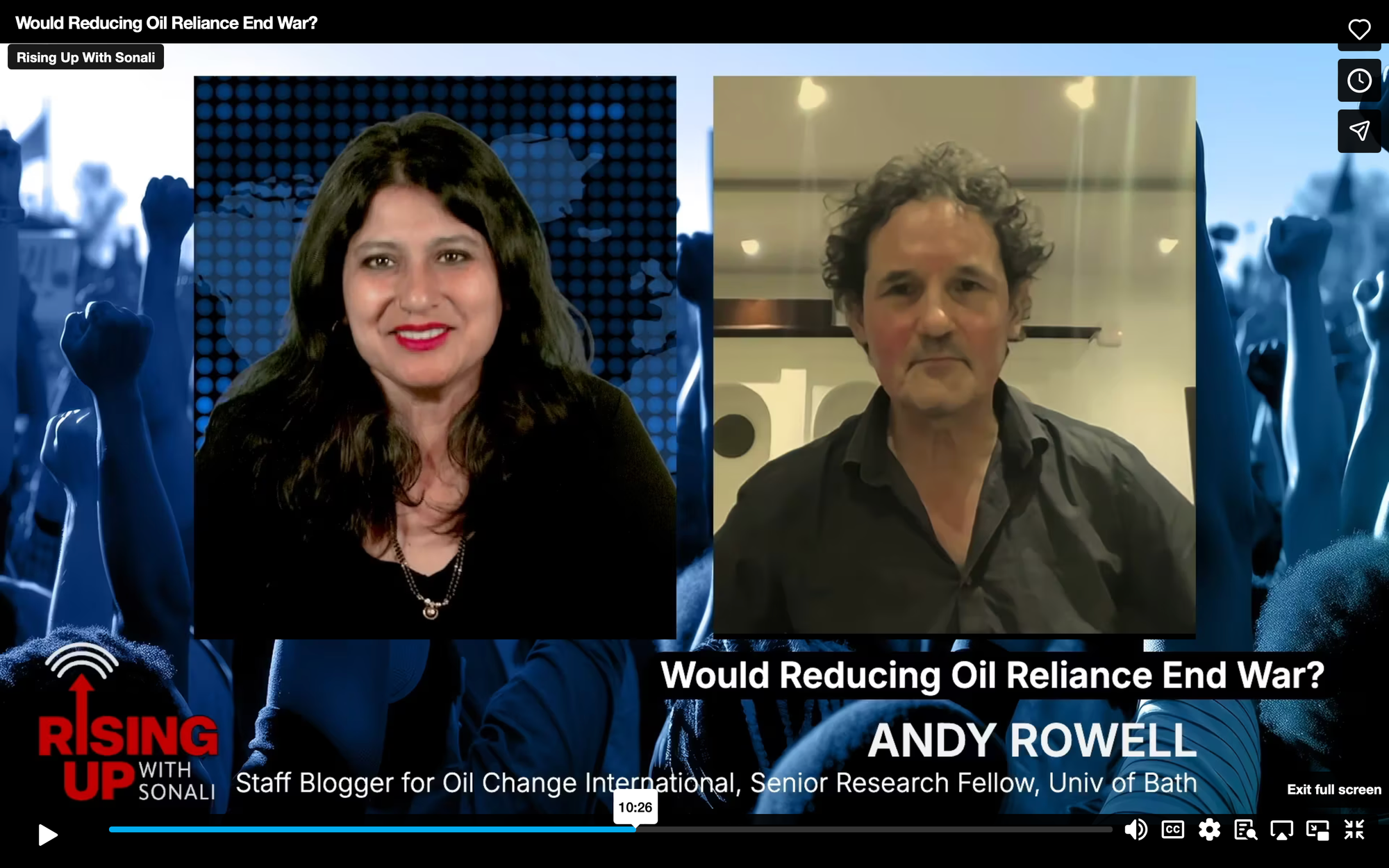
FEATURING ANDY ROWELL - The US-Israel war on Iran has thrown the oil-based global economy into a tailspin. In retaliation for airstrikes, Iran has been targeting ships in the Strait of Hormuz, the narrow waterway abutting Iran and Gulf Arab states through which oil tankers pass. Not only is the war sending oil prices skyrocketing, it’s also impacting the price of transported goods that rely on oil-fueled shipping.
Meanwhile, our reliance on fossil fuels is manifesting in extreme temperatures everywhere including in the US where frigid weather on the East Coast was followed by a record breaking heat wave on the West Coast.
Andy Rowell is an editor for Oil Change International in addition to working as a freelance writer and investigative journalist who specializes in environmental, health and lobbying issues. He is an honorary research Research Fellow at the University of Bath and has written about how the US-Israel war on Iran is highlighting the vulnerability of a global oil-based economy. He spoke with Sonali Kolhatkar about how a decentralized renewable energy economy could reduce incentives for war.
ROUGH TRANSCRIPT:
Sonali Kolhatkar: You just wrote an article called "Trump and Israel's War on Iran Once Again Exposes the Folly of Fossil Fuel Dependence." So, take us through that logic. Iran is one of the world's major oil producers, but there are plenty of other oil producers as well: Russia, the US also produces its own oil. We have Venezuela. Why is this particular war exposing how dependent the global economy is on this one narrow waterway?
Andy Rowell: Yeah, fundamentally, the oil and gas industry is an international integrated industry. And you might think that consumers in the US, if you listen to President Trump, it's like, "Hey, we're energy independent, and that energy's going to stay in the US." Well, of course it's not. It gets exported. And so, it's a global industry. And a fifth of the world's oil and gas passes through the Strait of Hormuz every single day.
So suddenly, a fifth of that oil has been switched off, that the tankers can't go through. And you've also got the added problem that because of the threats to mainly Saudi Arabia and the UAE, that basically they are no longer producing. And so, you've got the world's energy watchdog the International Energy Agency calling this the worst crisis in living memory for the oil and gas industry. This is worse than the ’73 price shock and the 2022 Ukraine war combined.
So, it's complete crisis. And once again, it shows the folly of being... It's nonsensical that you and I, as global consumers, not only is the price of gas rising, but the price of food will rise. And everything is so interlinked because we're so dependent on fossil fuels, and that's this 20 -mile strait of Hormuz.