How North Carolina’s Immigrant Rights Movement Fought ICE
Listen to story:
Download: mp3 (Duration: 27:37)
Unlock the video and transcript of this inspiring conversation for pennies a day!
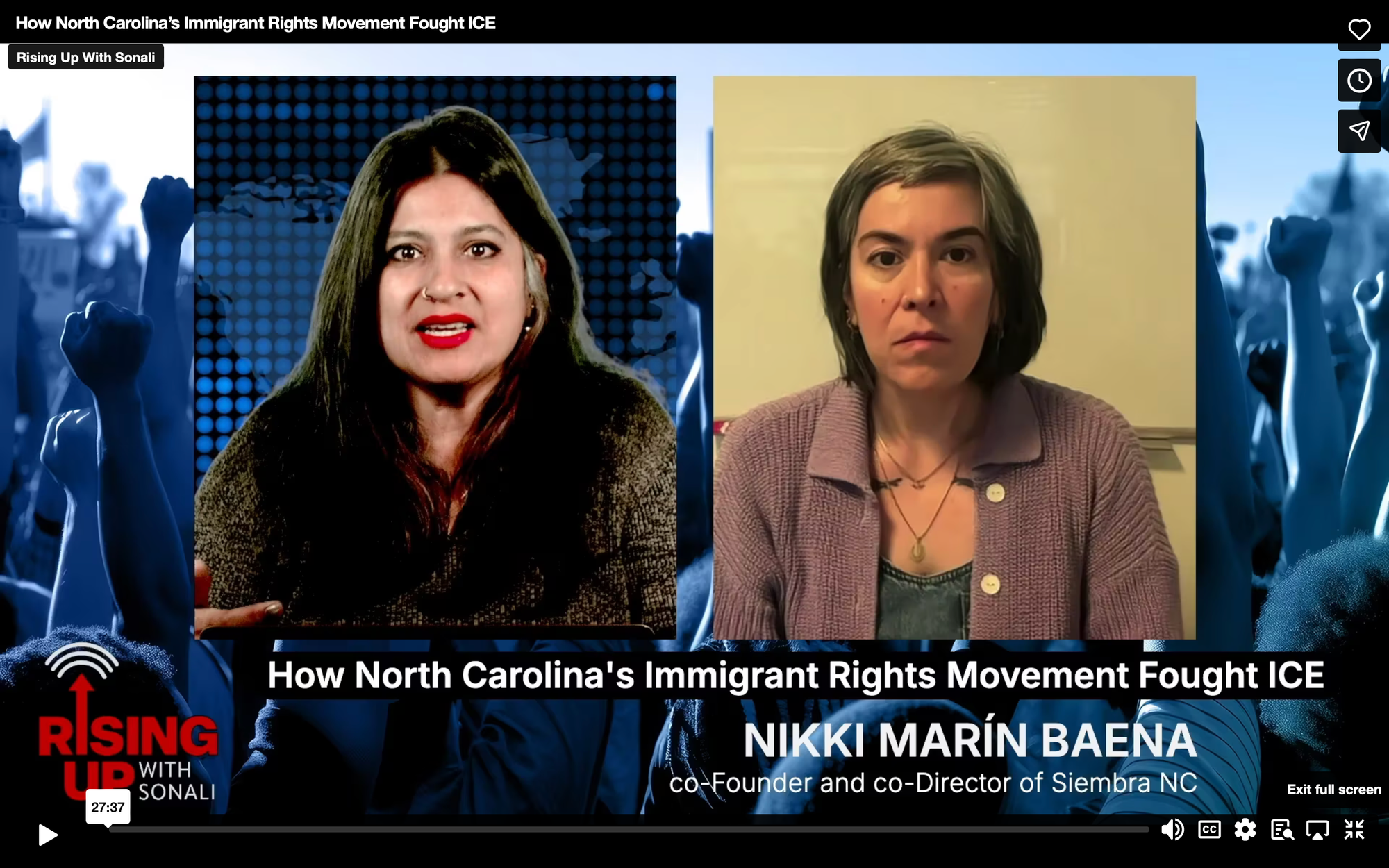
FEATURING NIKKI MARÍN BAENA - Although rural states such as North Carolina did not garner as much national attention for the 2025-26 federal assault as Minnesota and California, it was an epicenter of ICE operations in the South. With a growing population of immigrant workers, especially from Latin America, groups like Siembra NC have taken on the mantle of resisting immigration enforcement.
Calling itself a power-building community organization that focuses on immigrant and labor rights, Siembra NC established itself as a national leader, sharing resources with other groups.
Nikki Marín Baena is a co-founder and co-director at Siembra NC, a Latine base-building organization in North Carolina. She was previously finance director at Mijente, where she also helped coordinate the organization’s Sin El Estado work with activists in the U.S., Puerto Rico, and other parts of Latinoamérica. She is currently a core trainer at Training for Change and spoke with Sonali Kolhatkar about how her organization led North Carolina's anti-ICE resistance.
ROUGH TRANSCRIPT:
Sonali Kolhatkar: The ICE invasion of Minneapolis, Chicago, and Los Angeles garnered so much attention, but cities like Charlotte have also faced ICE terror even if we haven’t seen much national media. How big was ICE’s so-called Operation Charlotte’s Web at its peak?
Nikki Marín Baena: ICE agents are in Charlotte all the time. The Charlotte ICE field office is one of the biggest in the South. Since the beginning of 2025, Siembra NC had been tracking, along with other immigrant organizations in North Carolina, an increase in detentions in Mecklenburg County where Charlotte is located. All year we noticed detentions at ICE check-ins at court as well as at traffic stops.
As of November 15, 2025, in addition to the ICE presence we had Border Patrol head Greg Bovino and his agents coming into Charlotte. This was very unusual. Historically we don't think of Charlotte as a border city. But under the Trump administration, Border Patrol’s jurisdiction is everywhere. Like ICE agents, Border Patrol agents are masked even though they have different training.
ICE agents are usually trying to do some kind of targeted enforcement operation and are looking for specific people, although they might detain someone else on the way to finding that person. They call that a collateral arrest. But the Border Patrol enforcement was random. There were agents hanging out at gas stations, in parking lots, looking to see who they could detain.
GUEST: Nikki Marín Baena is a co-founder and co-director at Siembra NC, a Latine base-building organization in North Carolina.
Kolhatkar: How immigrant-heavy is North Carolina?
Baena: Charlotte, North Carolina has the largest immigrant population in the state, and it's growing. But what makes it different from other cities with ICE presence such as LA, Chicago or even Minneapolis, is that the population is more spread out, and not as dense. It can take a really long time, especially during rush hour, to get from one side of Charlotte to the other.
Kolhatkar: How has Siembra NC responded to the ICE and CBP presence?
Baena: In North Carolina, during the 2018 midterm elections which took place under the first Trump Administration, densely populated counties elected a bunch of progressive sheriffs, almost as a backlash to the 2016 presidential election. Many of them said they were going to end their ICE collaboration programs. Then in 2019, ICE did what at the time, felt like a very big operation here, where they detained over 200 people in about 10 days across the state. By then Siembra NC had setup a hotline. We had trained people to do what we call “verification,” which is documenting ICE presence and verifying that it is actually ICE and not some other law enforcement agency. The reason that we did that is because we noticed that even the rumor of ICE agents could totally shut down a neighborhood or a community. People would not go to school or work. We wanted to be able to help people make decisions about how to go about their day with the best information possible.
We already set up a lot of that infrastructure in the first Trump administration. A lot of it is just helping people do their own fact checking for their neighborhood, for their community. In 2025, after the inauguration of this second administration, we just saw a level of panic and a level of rumor-spreading that we had never experienced before. We once more tried to help people know what questions to ask, what they're looking for, both inside and outside immigrant communities.
In addition to that, people reached out to us requesting things like trainings for their church because their congregants were afraid to come to services. We had already been doing such trainings but the need for them grew very quickly in a short period of time.
Kolhatkar: It sounds like it was a matter of increasing outreach and rapidly escalating your reach in this second term. What about sharing your model of community defense with the rest of the nation?
Baena: In early 2025, we launched our “Defend and Recruit” playbook that people can download from our website. Part of the reason we did that was because we foresaw that this thing that we figured out, other people are going to have to figure it out. And maybe we can help them learn so many things the hard way if we share some of our best practices and some of our learnings.
But our longer-term goal for North Carolina is to create a bigger base of support so that we can build more political power and stop and this from happening again. We studied other groups that have done similar things and learned a lot from ISAIAH in Minnesota, an interfaith community organizing group that built teams and structures to broaden their base of support.
By the time Border Patrol came to North Carolina, we were able to learn how to expand our capacity and how to have more tiers of volunteers doing things so that more people could get trained to meet the situation.
Kolhatkar: When we saw the ICE surge in other parts of the country, people came up with some very unique and interesting ways to take on federal agents, including rapid response community organizing where they would put out information really quickly about where ICE was and then bring people out to challenge and confront them with bullhorns. In Chicago and Minneapolis, people are using whistles to alert others about ICE. Did you adopt some of those newer and more innovative ways of responding to ICE or did they not apply because of the unique geography and culture of North Carolina?
Baena: We knew that in the trainings we did before Border Patrol showed up, we had to prepare people to witness a detention. We advise people that if there are just two of them, the most important thing is to document the arrest and to try to get the name of the person being detained. We've seen in other places like Chicago when people were unconstitutionally arrested, such documentation was very useful in court to be able to get that person out.
But if there are four people witnessing an ICE arrest, two of them should document it the other two should alert folks on the perimeter to what's happening, such as yelling “Hey, there's, there's an ICE operation happening around here, just a heads up.”
And if there are more than four people, we advised people to sing.
Kolhatkar: Sing?
Baena: Yes. We had the whistles but what we really want to do in a situation of an ICE arrest is to help people stay calm. We’ve learned from the long history of the Civil Rights movement how important singing was. In our training, we had people practice singing This Little Light of Mine. Singing can help lower the temperature. That was one of the things that we did differently.
I really liked the Portland, Oregon response to ICE with the inflatable animal costumes but we didn’t get to do that.
Kolhatkar: One of the things that I noticed that Siembra NC does is help immigrant workers recover lost wages or stolen wages. Why is that an important part of your work and how does it fit with protecting immigrant workers?
Baena: North Carolina has for years ranked as the worst state in the United States to be a worker. That's because of a combination of circumstances, one of which is that it’s a “right to work” state. Also, the minimum wage is very low and there are very few workplace protections. Our cities are growing quickly, in large part due to immigrant workers. In Charlotte, Raleigh, and Durham, there are construction sites everywhere and a lot of that work is being done by immigrant workers.
Very often those immigrant workers are the subcontractor of a subcontractor of a subcontractor—a long chain in construction. When people don't get paid, they often think there's nothing they can do about it. They might think, it’s only a problem if I haven't been paid $10,000 or $20,000. But really, for an individual who did a paint job and didn't get paid their thousand dollar fee, in some ways that’s even worse because they were likely counting on that money to pay their rent and groceries.
Siembra NC does intakes with such workers and help them figure out what their situation is and help them collect information and proof. We do workshops for workers to ensure they have the right documentation when getting hired in order to protect themselves. Every one of these workers deserves to live a dignified life. Workers in North Carolina are being mistreated and undervalued and we want to change that.
Kolhatkar: It sounds as though it’s a systemic feature, that if you can keep workers living in fear of immigration enforcement, it's easier to steal their wages, it's easier to exploit their labor. Is that why Siembra NC wants to build political power, in order to change the system?
Baena: Yes, absolutely. The only thing that will change our current conditions is building political power. And in order to do that, you need lots of organized people. But when people are afraid to leave their homes for fear of being randomly detained—and at this point, even US citizens are afraid they will be targeted based on their race—they are not likely to organize. The same is true if they’re not getting paid for one out of every four jobs they do. If they're struggling to make ends meet, they're not likely to organize.
Kolhatkar: How does North Carolina fit with the national political context? I assume you aren’t counting on base building for the Democratic Party because leaders like Joe Biden and Kamala Harris haven’t exactly been pro-immigrant.
Baena: This was also something we learned from Minnesota, that we need to build the kind of power where we can negotiate with elected officials rather than work to elect them. I think North Carolina is important nationally in that it’s growing very quickly. It's a state that is 50% rural, so it has a lot of the qualities of what the US is.
North Carolina is also an interesting state politically because before the period of 2010-2014, the state had basically been run by the Democratic Party for a hundred years. In some ways, the national rightwing takeover, that is what happened in North Carolina between 2010 and 2014. So, it’s an important state to learn from about how the rightwing playbook works, how the right makes their own district maps and wins elections, and takes over institutions like public universities. And at the same time, it’s an important case study in how we organize and fight back.
Kolhatkar: How is your organization engaged in culture shifting. Although the immigrant population is growing, people of immigrant origin are still a minority in many states. How are you reaching out to justice-loving white North Carolinians to become your allies?
Baena: Something that is very unique to our state is that we live with each other. There's a rural county, Randolph, just south of where I live, and a lot of the Latinos I know work in textile factories there. They work alongside rural white people. And many of those white people identify as conservatives, but they are living alongside these Latino workers. They have relationships, they're friends. That’s very common here.
People form these ties all the time, and they see that as being separate from their political life. Part of what we end up trying to invite people into is to remind them that it is part of your political life that you have these relationships. That is really important.
And then with our wage theft work, we could have an office of caseworkers where workers come in and we call the boss, and then we sue the boss and keep the interactions one-on-one and private. But we choose to be very public with our wage theft actions, because we want to tell the story that when this happens to one worker, it is the entire community's problem. That's the way we've tried to talk about things like immigration enforcement too. When one person is unconstitutionally arrested, that is not just that person or their family's problem, it’s everybody in that community's problem. We don't want to live in a place where that happens.
I really do believe that most people in the state of North Carolina don't see themselves as part of a rightwing agenda to defund public schools. We help people see that when such things happen, they have to take action.
Kolhatkar: What does it look like for Siembra NC to build political power in a concrete sense, not just among Latinos but other non-Latino immigrants and Black residents?
Baena: Yes, in recent years non-Latino people started approaching us saying they also want to build power like we are doing. We started a project called Make NC Work so that we could have a multiracial organizing space alongside our Latino organizing. Siembra NC members have worked with Make NC Work members around Fourth Amendment workplaces, which is the idea that if there is an employer who is an ally rather than a perpetrator, what can that employer do to protect their workers if ICE shows up. So, instead of doing Know Your Rights workshops only for Immigrant Communities, we started doing these Fourth Amendment workplace trainings for employers and for business owners about what to do if their rights were being violated. Your Fourth Amendment rights get violated if a federal agent comes into your private space without a warrant.
So, we trained them on how to ask for a judicial warrant rather than an administrative warrant. We canvassed more a thousand businesses across the state and many of them have become Fourth Amendment workplaces. And some cities in North Carolina even started passing Fourth Amendment workplace resolutions.
This is a good first step in the direction of saying that a lot of North Carolinians are being impacted by government overreach. One kind of government overreach is unconstitutional ICE arrests and another kind is how cities and counties are being impacted by significant cuts embedded in the so-called Big Beautiful Bill.
We're about to launch an exciting project called the Enough Should Be Enough Listening Tour which involves Latino and non-Latino community members going to their workplaces, churches, schools, neighborhoods, to find out what people in North Carolina actually want for their state.