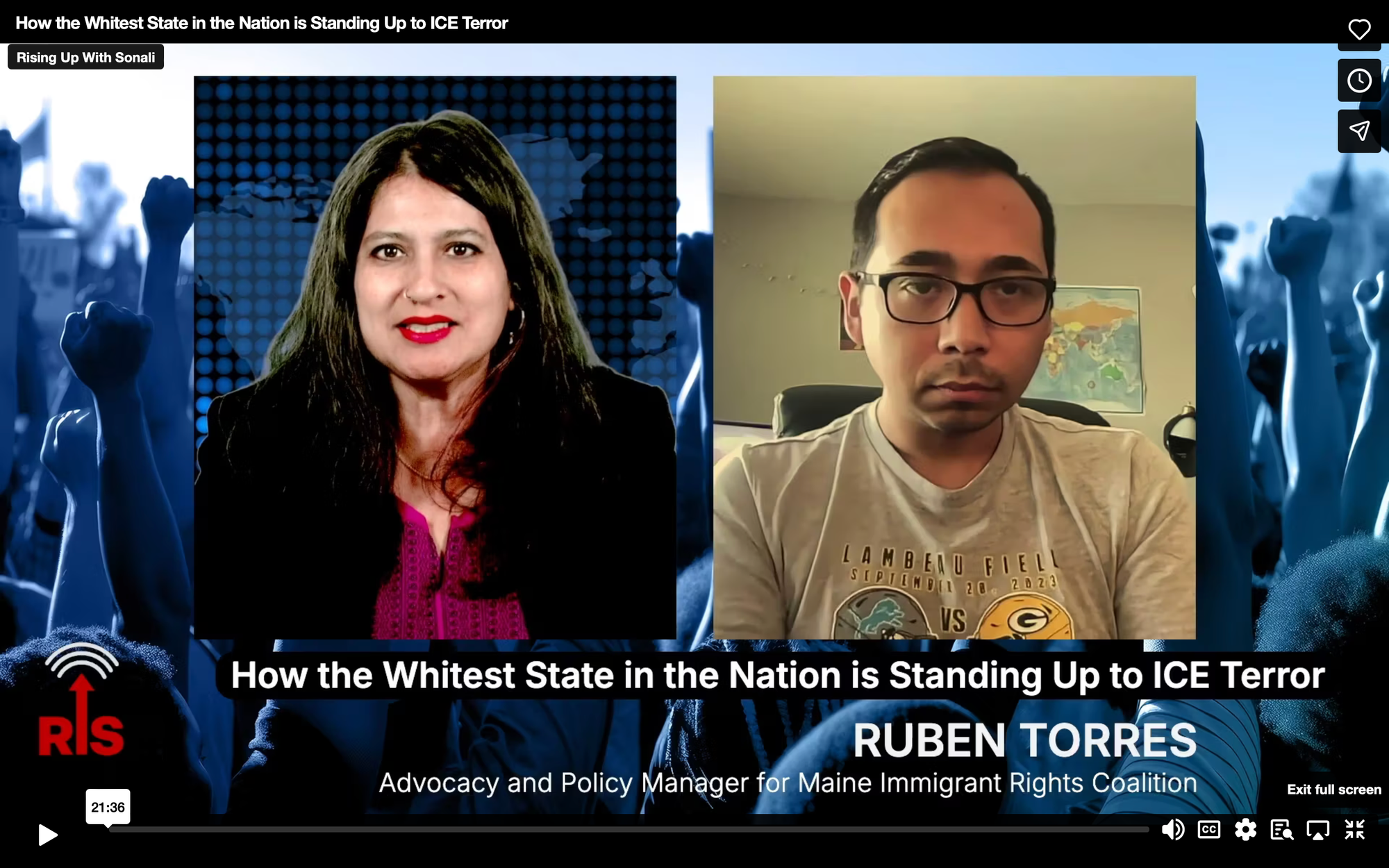
FEATURING RUBEN TORRES - The Trump administration has imposed federal immigration enforcement agents on states around the nation, including ones where the immigrant population is relatively minuscule. This includes Maine, the whitest state in the nation, where a mere 4% of the population is of immigrant origin. ICE agents have wreaked havoc on the state, and even after Republican Senator Susan Collins of Maine requested an end to the operations, tensions remain high and ICE sightings continue.
But immigrant rights advocates have adopted the defensive measures that activists around the country have popularized. Ruben Torres is the Advocacy and Policy Manager for the Maine Immigrants' Rights Coalition. The coalition serves over 100 member organizations across the state of Maine seeking to improve legal, social, and economic conditions for immigrants in the state of Maine through advocacy, information sharing, and collaboration. He spoke with Sonali Kolhatkar about how activists are organizing anti-ICE resistance in Maine.
ROUGH TRANSCRIPT:
Sonali Kolhatkar: The language that ICE has been using in states around the country has been as dehumanizing as its actions, and in Maine, they have called their operation “Catch of the Day.” If there was ever dehumanizing language, literally reducing immigrants to fish being caught, we would be hard pressed to find anything worse than that. How has so-called Operation Catch of the Day actually played out? What does it look like on the ground?
Ruben Torres: Yeah, thank you. So, Operation Catch of the Day as it was dubbed by the federal government started on January 20th in the state of Maine where the Maine Immigrants’ Rights Coalition and our partners manage an immigrant defense hotline that has been colloquially known as the ICE Watch hotline.
But through that hotline, we're able to receive calls and monitor situations on the ground from community members to better provide them resources and understand what issues they're facing. Through that hotline, we were able to really get a good understanding of the community needs, through conversations with community members themselves directly. We also hosted a lot of community conversations with immigrant community leaders from across the state to understand how this was playing out in their communities.
Overall, while the rhetoric claims to have been targeting the worst of the worst and going after criminals, the reality is that we saw something completely different. We saw families being torn apart, grocery stores and places that were considered safe and routine in everyday life have all of a sudden lost that security blanket, and people are fearful and scared of what the world has changed into.