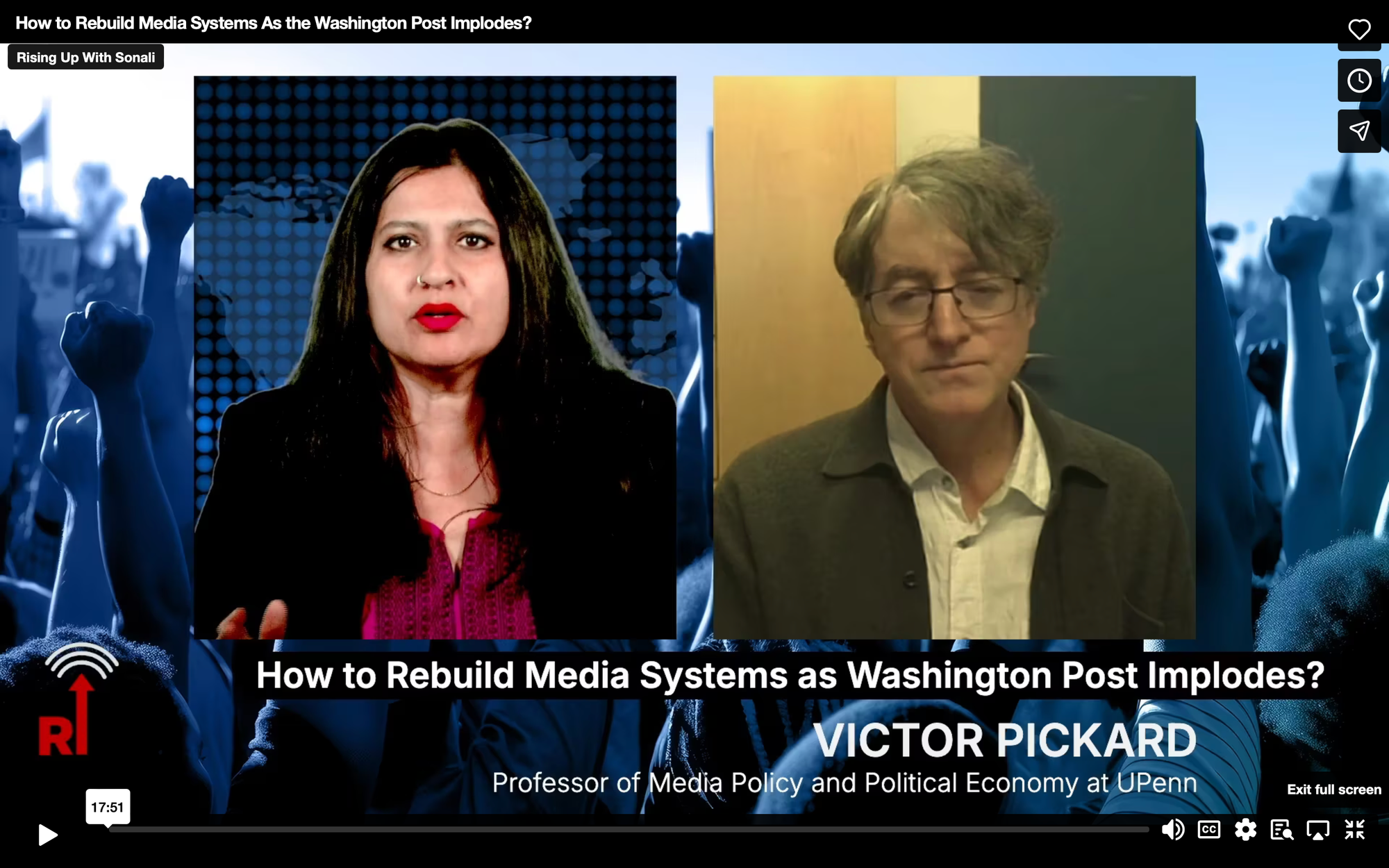
FEATURING VICTOR PICKARD - In one of the largest mass firings of any media outlet in history, the Washington Post recently laid off hundreds of employees, or nearly one third of its entire workforce. Owned by one of the world’s richest men, Jeff Bezos, the paper has lost huge numbers of subscribers, in large part because of the 2024 decision by Bezos to end presidential endorsements.
The paper’s publisher, Will Lewis justified the firings saying, “difficult decisions have been taken in order to ensure the sustainable future of The Post so it can for many years ahead publish high-quality nonpartisan news.” Lewis also announced his own resignation, in which he thanked Bezos, saying “The institution could not have a better owner.”
What does the Washington Post’s decimation mean for an already-fractured news industry?
Victor Pickard is a professor of media policy and political economy at the University of Pennsylvania’s Annenberg School for Communication, where he co-directs the Media, Inequality & Change Center. He has authored several books, including Democracy without Journalism? and America’s Battle for Media Democracy. He spoke with Sonali Kolhatkar about why The Washington Post is being destroyed and what, if anything, can come out of it?
ROUGH TRANSCRIPT:
Sonali Kolhatkar: First, let's talk about why the Washington Post had been failing, because that's the big question at the heart of the decisions its new owner claims he's taking. He's saying that he's simply using data to justify how to fix the outlet, but the fact is that it had been losing a lot of subscribers. Now, I pointed out that 2024 that decision to not endorse presidential candidates may have had a lot to do with, and indeed it was documented that hundreds of thousands of people did end their subscriptions. Is it a lack of subscriptions that you think has led to this?
Victor Pickard: Well, that's certainly a contributing factor, and I think there are at least two general narratives here that we could point to, to try to make sense of what just happened to the Washington Post. One is, as you already suggested, that there's been a series of mismanagement moves, you might call them, over the last year or so where you know, not only has there been a kind of exodus of subscribers, NPR reported that after that decision to spike the endorsement for Kamala Harris, they lost 250,000 subscribers. That was a major blow to their subscription base.
And then there have been other moves such as the shift to the right of their editorial pages where they've been instructed to focus on personal liberties and free markets. So there's been all this meddling from above into the Washington Post's news production, which isn't supposed to happen.