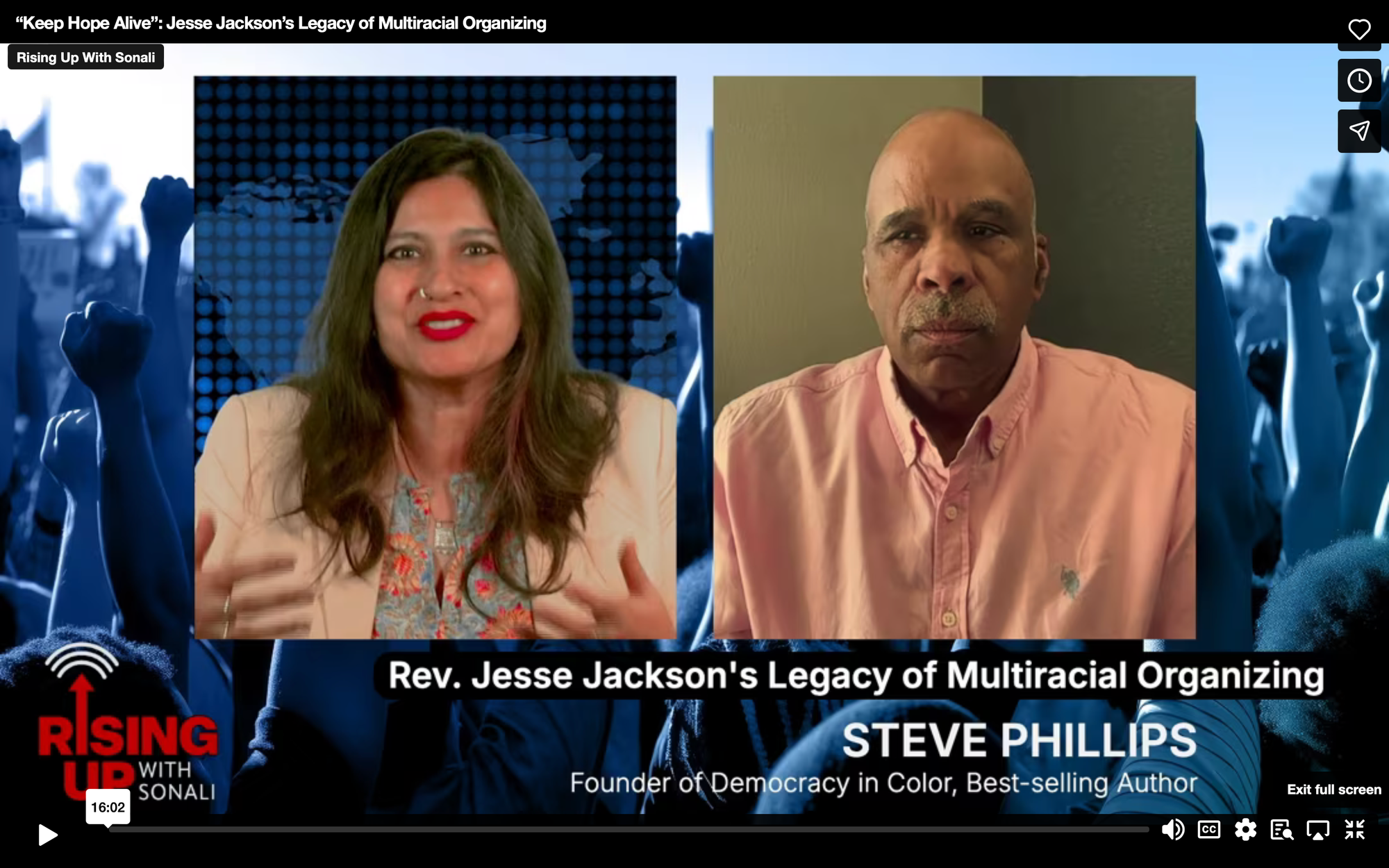
FEATURING STEVE PHILLIPS - Before figures like Alexandria Ocasio-Cortez, Ilhan Omar, and Zohran Mamdani appeared on the national stage, there was Rev. Jesse Jackson and his Rainbow/PUSH coalition, bringing together a broad-based multiracial progressive network of people and causes to the forefront of politics. Rev. Jackson, presidential candidate and legendary civil rights activist, passed away on February 17 at the age of 84.
Jackson’s legacy is rich with advocacy for the poor and people of color, for voting rights, education, healthcare, and workers’ rights. He will lie in state in South Carolina where he is from. Following that, his body will be transported to Chicago for a major celebration of life. Rev. Jackson spent the majority of his life in Chicago where the Rainbow/PUSH Coalition is headquartered.
Steve Phillips is a national political leader, bestselling author, and columnist. He is the author of The New York Times bestseller Brown Is the New White: How the Demographic Revolution Has Created a New American Majority and the national bestselling book How We Win the Civil War: Securing a Multiracial Democracy and Ending White Supremacy for Good. He is also a columnist for The Guardian and The Nation and the host of the podcast, “Democracy in Color with Steve Phillips.” He is the founder of Democracy in Color, a political media organization. He spoke with Sonali Kolhatkar about Rev. Jackson's legacy and its relevance to today.
ROUGH TRANSCRIPT:
Sonali Kolhatkar: You were one of the first people I thought about when I thought about Reverend Jackson, given this legacy that he leaves behind, where he was really one of the first people—of course there was so many civil rights activists and leaders who did that—but he really was so prominent in bringing this idea of non-white Americans, people of color across racial lines, joining together, uniting to make their agenda, and to force it to be heard on a national political landscape. How much do you attribute your work to the legacy of Reverend Jackson?
Steve Phillips: Uh, all of it. Reverend Jackson was the single most important informative force in terms of who I am and what I do. And I was 20 years old when he first ran for president in 1984. I served as a delegate. I was the statewide student coordinator for the Rainbow Coalition for the 1988 campaign.
And the example that he provided was just so powerful and compelling around what politics should be and where it should go. He was very much a direct bridge between the Civil Rights Movement, somebody who was literally there at the time Dr. King was assassinated at the Lorraine Motel in Memphis Tennessee, and bringing that vision, those values, and probably most important, that coalition into the electoral political process in the 1980s in a fundamental fashion that both, impacted politics, but also showed and illuminated the path forward for how to go about winning.
This concept that when the old minorities come together, they comprise a new majority. It is in essence, the coalition that elected Barack Obama and offers the greatest hope for the future of politics in this country.