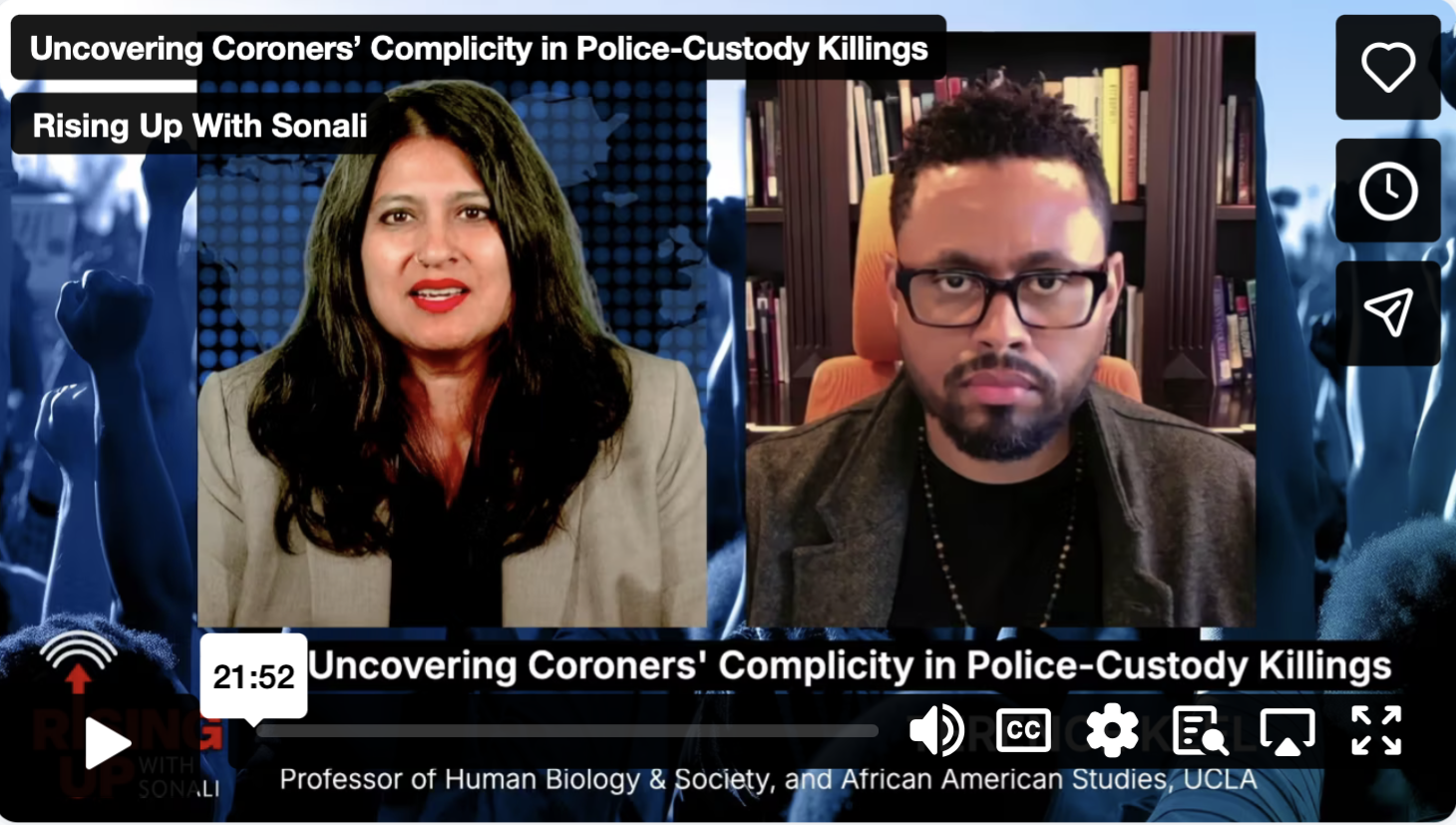
FEATURING TERENCE KEEL - Five years after the record-breaking racial justice protests around the United States in response to the police murder of George Floyd, law enforcement continues to kill more than a thousand people a year nationwide. Now, a new book reveals how coroners and other death investigators help cover up police injustices and are effectively complicit.
Terence Keel is a Professor of Human Biology & Society, and African American Studies at the University of California, Los Angeles. He is the author of The Coroner’s Silence: Death Records and the Hidden Victims of Police Violence and spoke with Sonali Kolhatkar about it.
ROUGH TRANSCRIPT:
Sonali Kolhatkar: So, when we think about the issue of police violence, we often picture the horrific things that happen to men like Eric Garner or George Floyd. But maybe we don't think about the things that happen that are not within our view, that aren't captured by cameras. And we certainly don't necessarily think about what happens when people are in police custody, in jails in particular, meaning they haven't even been charged or convicted often. Tell me what pulled you into writing this book that really tells a story, I think, that is an under-covered aspect of police violence.
Terence Keel: You know, Sonali, there were really two things that started all of this work for me. One was witnessing the public murder of George Floyd, and really, if we remember that moment—yes, it was a recorded death, and the medical examiner of him and Hennepin County wrote that it was a homicide.
But what was particularly troubling about his death record was an effort to say that his heart was the real cause for why he died. And if you might recall, the topline on the autopsy was cardiopulmonary arrest, complicating law enforcement subdual. Essentially [they were saying] George Floyd had a bad heart [and] because he had a bad heart, police had to use more force, and that force was ultimately what took his life.
And I remember reading that and watching the reaction around the world, and it occurred to me how many more records are written like this? How many more cases are there where people die in police custody, either during arrest or during jail or in jail, and the death investigator blames the victim and uses their own preexisting condition or their body to really explain what happened.