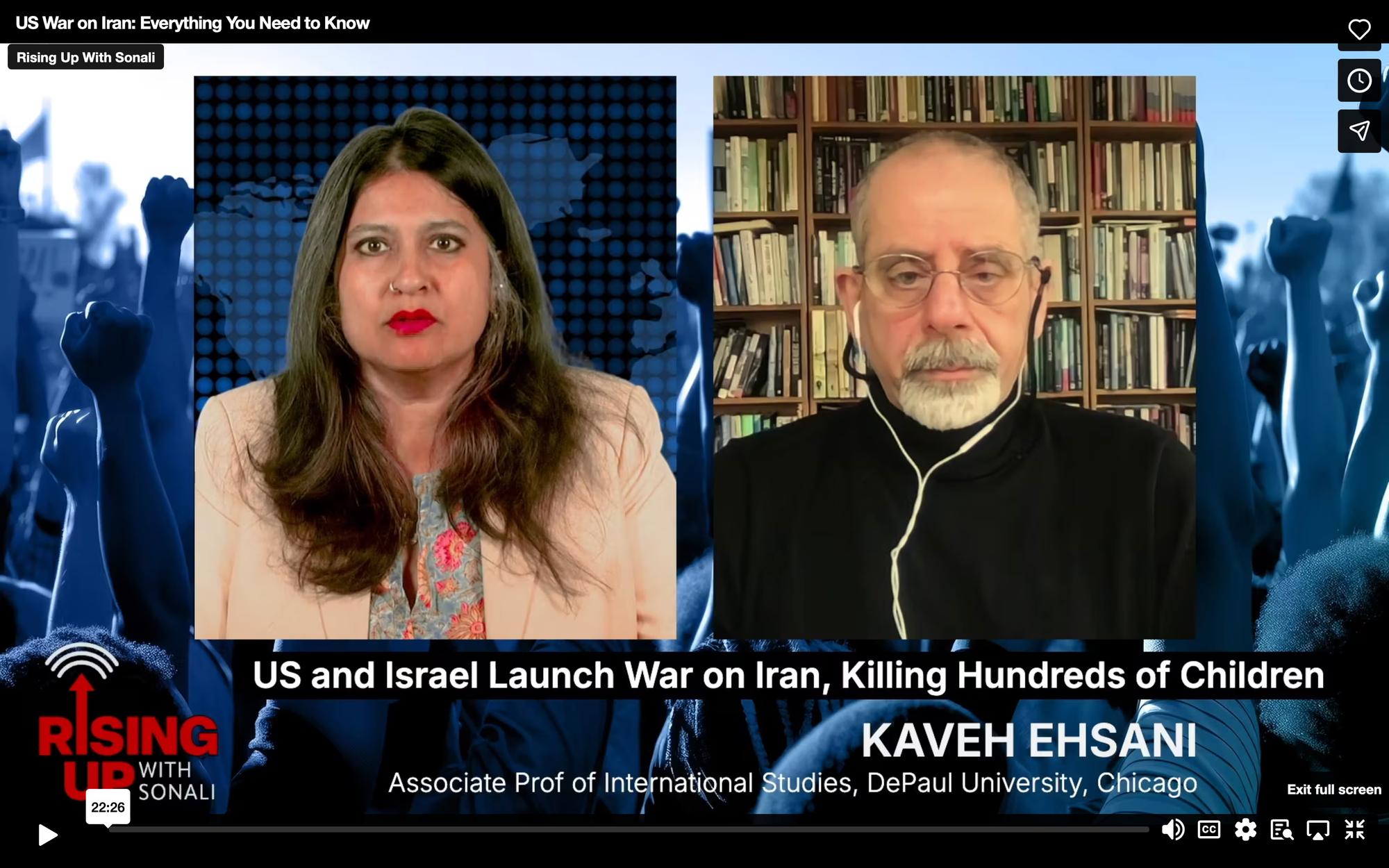
FEATURING KAVEH EHSANI - The Iranian Red Crescent Society is reporting that nearly 800 Iranians have been killed in US and Israeli air strikes since the Trump Administration launched an illegal war on Iran on February 28 without Congressional approval.
Among the first targets of US and Israeli bombs was an elementary girls school in the southern Iranian city of Minab where 175 people, most of them children, were killed. An Al Jazeera investigation has concluded that the strike on the school was most likely deliberate. The US and Israel’s airstrikes also resulted in the mass extrajudicial assassinations of Iran’s Supreme Leader Ayatollah Khamenei and most of the nation’s top military commanders.
Iran has retaliated by aiming drone airstrikes at US military bases located in neighboring Gulf Arab nations including the United Arab Emirates, Bahrain, Saudi Arabia, Qatar, and Iraq.
Donald Trump, who had proclaimed himself the so-called peace president, has, in typical fashion, contradicted himself and said that the Iran war would last weeks or a lot longer.
Kaveh Ehsani is associate professor of International Studies at DePaul University in Chicago. He is a contributing editor of MERIP (Middle East Report) and sits on its board of directors. He spoke with Sonali Kolhatkar about what the US-Israel war on Iran means.
ROUGH TRANSCRIPT:
Sonali Kolhatkar: First of all, we had expected that the US would attack Iran. There were a lot of threats being made, and the airstrikes launched February 28th. You and I are speaking on Tuesday, March 3rd. A lot has happened in just a handful of days, including a spectacularly large number of civilian casualties and the wiping out of Iran's leadership—how have you been feeling through all of this, as somebody who studies what's happening there, I imagine you have family there—give me your initial thoughts on this war that threatens to destabilize the entire area?
Kaveh Ehsani: Um… despondence. I mean, knowing and being aware of the history of similar conflicts in the region. For example, Iraq, Libya, Afghanistan Syria. The future looks really bleak. This will have devastating consequences in the long run, not just for Iran, but internationally. There's nothing to feel good about in this process. But the worst thing is that this war will probably put an end, it will probably fail to achieve one of its stated goals. I mean there are at least half a dozen supposed stated goals that have been uttered by the Trump administration. But one of them is regime change. I don't think it will lead to that.
The Iranian political leadership is pretty well established. It has supporters. It has a military infrastructure. It controls the economy, for better or for worse. So this will not lead to that, to any kind of regime change. But it will lead to greater repression at home more pauperization of the Iranian population.