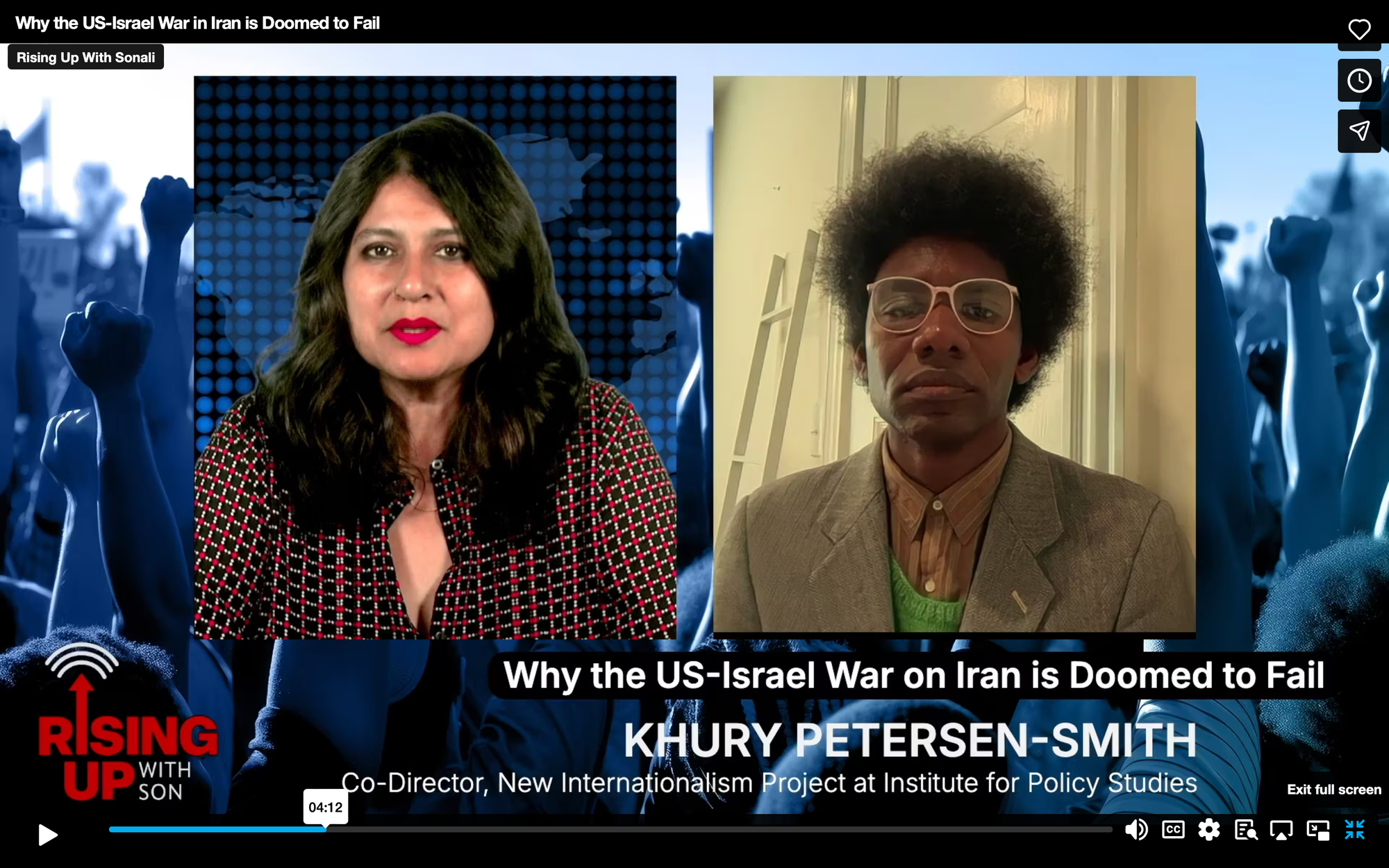
"There's no question that they underestimated Iran, and that they overestimated US power. I really think that Trump and Hegseth are convinced by their own sense of arrogance and hubris, frankly," says Khury Petersen-Smith in this fascinating conversation.
Unlock this interview for ONLY $4 a month (5-day free trial)
FEATURING KHURY PETERSEN-SMITH - President Donald Trump is very upset that European nations such as Britain and France have thus far refused to join the US-Israel war on Iran that Europe never asked for. His angry words, “Go get your own oil,” came in the wake of reports that Spain had closed its airspace to US warplanes headed to Iran.
Meanwhile, Trump has threatened to bomb Iran’s desalination plants, which is civilian infrastructure that millions of Iranians rely on for water. Under international law it is illegal to hit civilian targets in war, but that hasn’t stopped the US and Israel from bombing schools. The Trump administration is now reportedly weighing whether to start a ground war in Iran.
Khury Petersen-Smith, Michael Ratner Middle East Fellow and the Co-Director of the New Internationalism Project at the Institute for Policy Studies. His specialty is U.S. militarism in the Middle East and in the Pacific, and movements that resist it. He spoke with Sonali Kolhatkar about the state of the war.
ROUGH TRANSCRIPT:
Sonali Kolhatkar: This war, as I mentioned, nobody asked for other than Israel, seems to have no real clear aim, and Trump has created deadlines and then extended them. He's issued threats. He's claimed Iran is already decimated, and has a two-week timeline for wrapping it up, or two-month timeline for the entire war. Every day it seems as though something different comes up. Can you make sense of it? Is there any rhyme or reason, not that war is ever logical or rational, but can you make any rhyme or reason of Trump's and Netanyahu's aims?
Khury Petersen-Smith: Yeah. It's an important question. I will say that there has been a longstanding desire by a section of the US elite to have a war with Iran, and that includes Donald Trump himself, who as early as said that the US should send troops to Iran in response to the hostage crisis of 1979.
And so, there's this kind of conversation now that this war came out of nowhere. And on one hand it was certainly an unprovoked war, but on the other hand, at least for the past two decades, since the post-9/11 wars, and especially around the US invasion of Iraq, there was a very serious conversation in Washington about invading Iran as well.