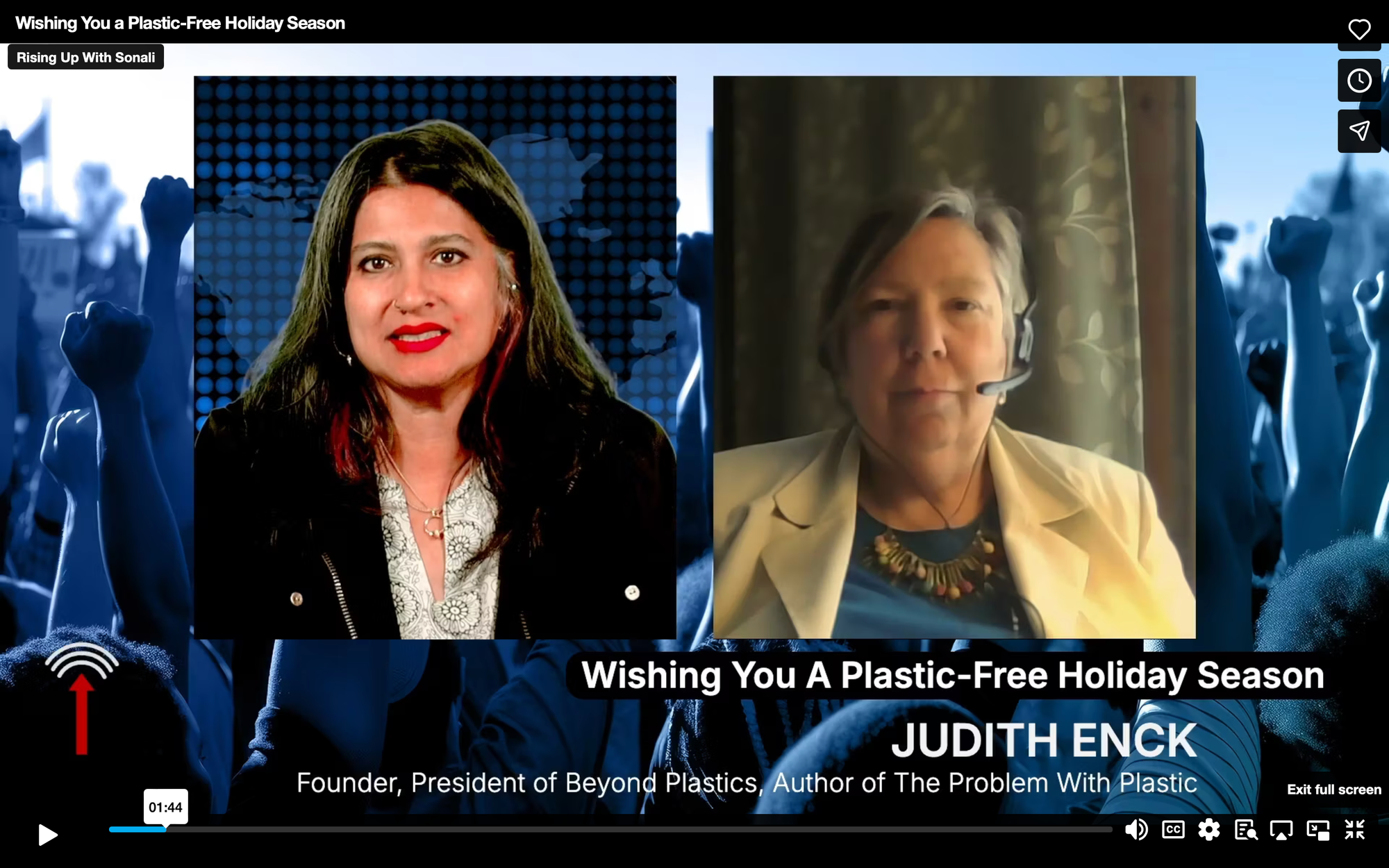
FEATURING JUDITH ENCK - We are awash in plastics, from the polyester clothing on our backs, to the glasses on our face, the polish on our nails, the packaging of our food, and even the microplastics flowing through our blood. In less than a century, plastic has revolutionized our lives and leaves a legacy that is slowly poisoning us.
Now, as we enter the thick of holiday season, the plastic consumption is ramping up, from plastic toys and gifts and giftwrap, to plastic-packaged foods and dinner ware and more.
Can we free ourselves of plastic? Yes we can, says Judith Enck, founder and president of Beyond Plastics, an organization whose goal is eliminating plastic pollution everywhere. Enck was appointed by President Obama to serve as regional administrator at the U.S. Environmental Protection Agency in 2009 and served as deputy secretary for the environment in the New York Governor’s Office.
Enck is currently a professor at Bennington College and the author of the new book The Problem With Plastic: How We Can Save Ourselves and Our Planet Before It’s Too Late. She spoke with Sonali Kolhatkar about how people can take political action, and how you can have a plastic-free holiday this year.
ROUGH TRANSCRIPT:
Sonali Kolhatkar: I think a lot of people understand now that plastic is a problem, but maybe they're not as aware just how deeply embedded it is in our lives and actually, in our bodies itself. I remember the first time I read about microplastics polluting the ocean, you know, from those little tiny beads that some manufacturers decided it would be good to put in things like lotion and soap, to finding out that plastic filaments are in our bloodstream. And it was quite shocking. So how do you explain how that even happens? How does, how does plastic get into our bodies? We just surround ourselves with so much plastic, it's just everywhere now?
Judith Enck: Well, none of us voted for more plastic. the reason we have so much plastic is because there is a glut of fracked gas on the market. Historically, plastics were made from oil and chemicals. Today it's made from 16,000 different chemicals and ethane, which is a byproduct of fracking 'cause there's a glut of frack gas. Fossil fuel companies are using that waste product to produce new plastic products.
The way plastics get into our bodies is we're either breathing it in or we're swallowing, particularly from food and beverage packaging. And the health consequences are quite significant.
So, scientific researchers have found the presence of microplastics in our blood, our lungs, our kidney, our heart arteries, where they've seen microplastics attached to plaque. If you've got microplastics on plaque, you have a much greater risk of developing heart disease, stroke, premature death.