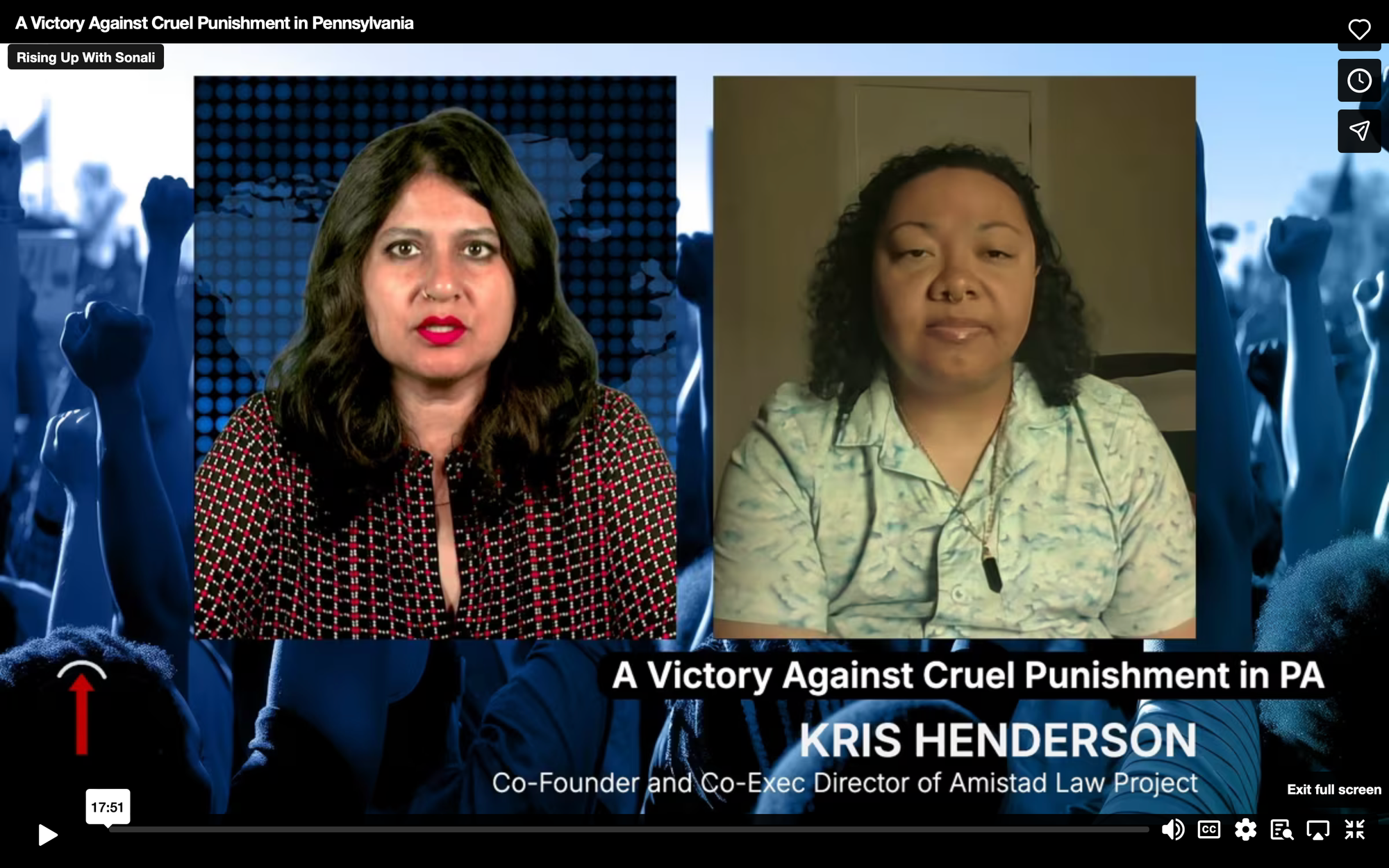
FEATURING KRIS HENDERSON - The State Supreme court of Pennsylvania has just struck down mandatory life sentences for felony murder convictions. Justices determined that a mandatory life sentence, “absent an assessment of culpability,” violates Pennsylvania’s constitution.
A felony murder conviction doesn’t mean the person convicted is directly responsible for a death, for someone can be convicted of a felony murder even if their actions indirectly and unintentionally resulted in someone’s death. Currently, more than a thousand people are serving such life sentences in Pennsylvania, and more than two thirds of them are Black.
Kris Henderson, Co-Founder and Co-Executive Director of Amistad Law Project. They are a movement lawyer, and a founding member of the Coalition to Abolish Death By Incarceration, and spoke with Sonali Kolhatkar about how the victory was won and what it means.
ROUGH TRANSCRIPT:
Sonali Kolhatkar: So, before we get into the actual decision itself, let's talk about the person whose case was at the heart of this particular case, who is a man named Derek Lee, who has been serving a life sentence, but whose direct actions did not cause the death that the particular case involved. Tell me about Derek’s story.
Kris Henderson: Yeah. I think that one of the things about felony murder, I think a lot of people don't realize, is that many people did not kill or intend to kill anyone. They were involved in a felony and someone died or was killed at some point during that situation. And then under Pennsylvania law, people have been able to be convicted of felony murder. And in Pennsylvania, up until now, the mandatory minimum has been life without parole for felony murder.
And Mr. Lee was one of these people who was involved in a felony, and someone died over the course of that felony, not as a direct cause of his actions, and still he was serving life without parole for felony murder, or as we call it, death by incarceration.