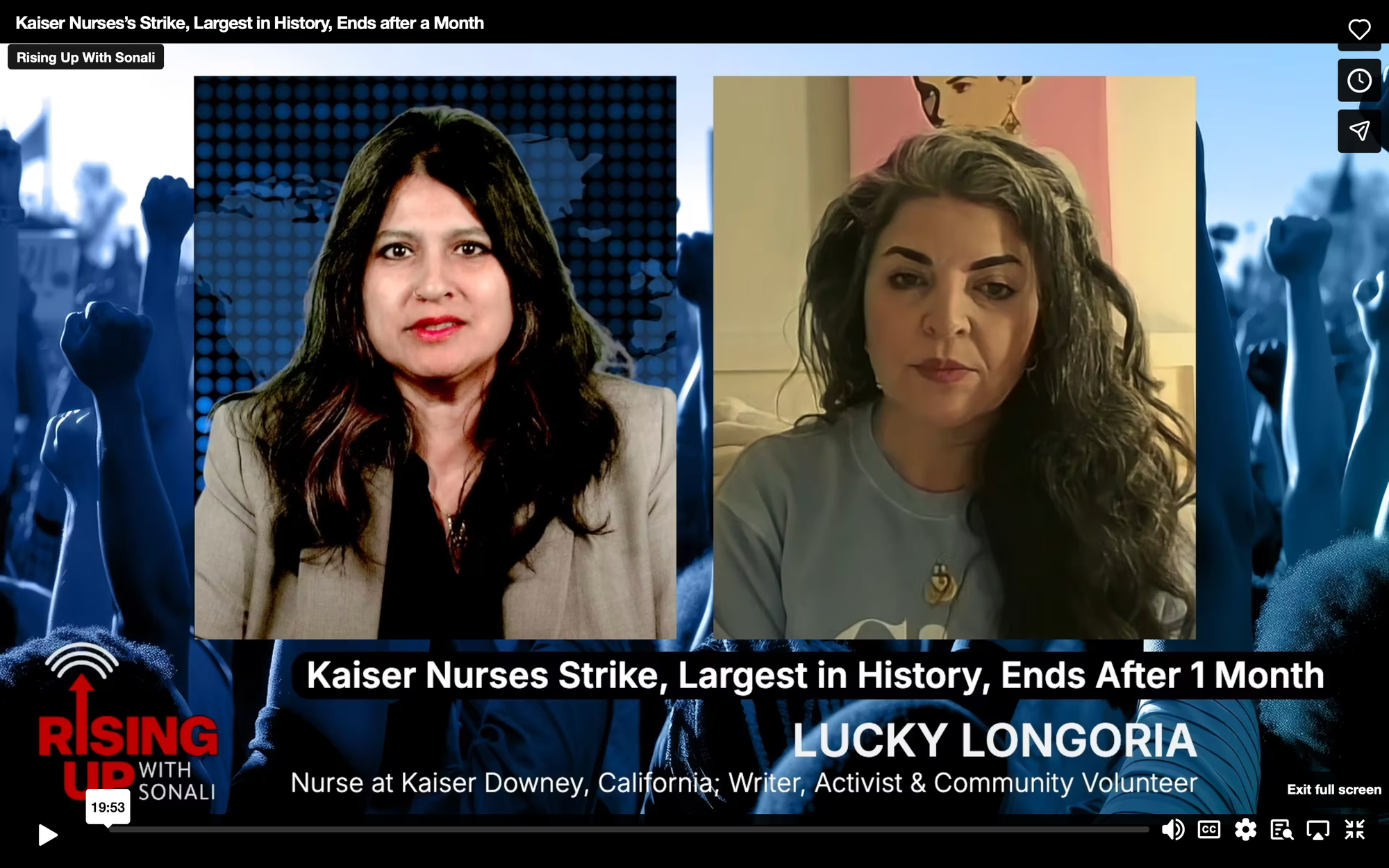
FEATURING LUCKY LONGORIA - More than 30,000 unionized workers at California and Hawaii facilities of Kaiser Permanente, one of the nation’s largest nonprofit healthcare providers, are returning to work after 4 weeks on the picket line. The nurses, lab technicians, pharmacists and others, are members of UNAC/UHCP, United Nurses Associations of California/Union of Health Care Professionals, which said the strike was the largest open-ended work stoppage of healthcare professionals in US history.
Workers say their salaries have not kept pace with inflation and that Kaiser doesn’t employ enough workers, which endangers patient safety. Meanwhile, Kaiser was found to be sitting on $66 billion in unrestricted reserves even as the company has continued increasing patient premiums and kept salaries flat. Further, the nurses union has reviewed Kaiser’s holdings and found that Kaiser Permanente Group Trust has investments in Geo group and CoreCivic, the nation’s largest private prison corporations with major government contracts to detain immigrants.
Lucky Longoria is a pediatric nurse at a Kaiser facility in Downey, California. And she’s a writer, activist, community volunteer, and member of UNAC/UHCP. She spoke with Sonali Kolhatkar about why her union was on strike and what they won.
ROUGH TRANSCRIPT:
Sonali Kolhatkar: Let's talk about what it was like to be on the picket line. you and I are speaking Tuesday, February 24th, which is the day basically that I understand is the official end of the work stoppage. What has it been like to be on the picket line for four weeks, to not be at work?
Lucky Longoria: The hardest thing about being on the picket line is having a loss of control when it comes to the patient care that's ongoing, even though we have to step away from the bedside. I'm a pediatric nurse. We have patients who come and they stay with us maybe a month at a time because they have chronic conditions. So, they're not just patients, they become family. And to know that you have no sense or understanding as to how they are, as to what the care is like that they're receiving, the worry, the stress of, of not knowing. You know, we are nurses, it's an occupation. but because our heart is most importantly the biggest asset we have as, as professionals, as nurses, as care providers, we don't leave the job when we clock out. So, we took the worry with us and the worry was with us on the line.