
Universal Child Care Is Popular. New Mexico Showed Us How We Can Win It.
Listen to story:
Download: mp3 (Duration: 17:12)
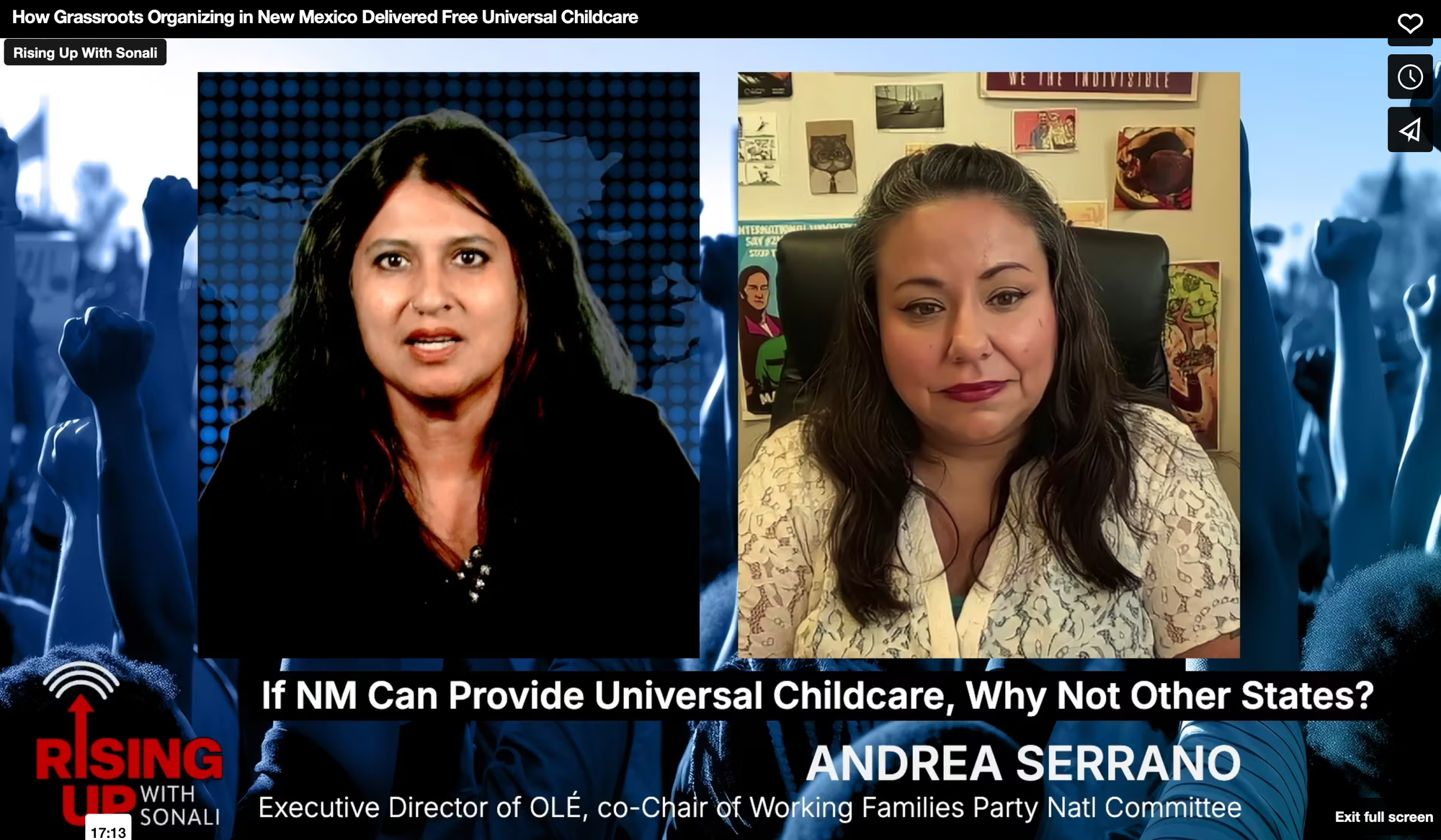
Upgrade your subscription to access the video and transcript of this interview. We hate paywalls too, but HEY, journalists gotta eat! 😌
FEATURING ANDREA SERRANO - The state of New Mexico just adopted a universal free childcare program, becoming the first state in the nation to do so.
For decades now, the cost of childcare as a fraction of people’s wages has continued to increase, leading to more women dropping out of the workforce and people who want to have children, choosing not to in order to make ends meet. At the same time, childcare provider wages dropped to among the lowest in the nation.
Progressives have been calling on government to step in and make free, publicly funded childcare available to all parents for years and were told such a thing was simply untenable. So, how did New Mexico make it happen?
Andrea Serrano is a life long New Mexican who has worked in social justice and advocacy for over 25 years. She began working at OLÉ in 2012 as a community organizer and became executive director in 2017, leading the organization’s electoral and political organizing. Andrea is also co-chair of the Working Families Party National Committee. She spoke with Sonali Kolhatkar about the movement that led to NM's childcare success story.
ROUGH TRANSCRIPT:
Sonali Kolhatkar: So, I understand that the news and the announcement was around New Mexico making childcare freely available to people regardless of income, meaning for everyone in New Mexico, but that is not something that came out of nowhere, right? It's been building for a few years and state government has been making the net wider and wider for people to the point now where basically anybody who is a parent in New Mexico can have free childcare provided by the government. Is that accurate?
Andrea Serrano: That's that is accurate. There are no income requirements for childcare assistance in the state of New Mexico, effectively creating universal childcare.
Kolhatkar: So take us through the steps of how it happened. you know, we can go back to 2022. You can go back even further than that. How did it all begin? It started out with New Mexico basically being one of the worst, if not the worst states in the nation when it came to childcare, right?
Serrano: Yes, for years New Mexico teetered between 48th, 49th and 50th in the state for child wellbeing. And in 2010, the idea to offer universal childcare came out of advocates including OLÉ, who, you know, really started to look at the state's funds come that come from oil and gas production.
GUEST: Andrea Serrano, Executive Director of OLÉ in New Mexico, Co-Chair of Working Families Party National Committee
And so, you know, part of the Permian Basin sits in New Mexico. We're one of the largest oil and gas producers in the country. and we have a land grant permanent fund. It's royalties that oil and gas pays to the state of New Mexico. And it goes into this fund that pays for education. It pays for some of the state institutions, you know, state hospitals, state universities.
And so, the idea was to increase the payout for education by 1% so that it can cover early childhood education. The way to do that in New Mexico is through constitutional amendment. And a constitutional amendment can go before voters only if the legislature passes it. And for 10 years, the legislature blocked the constitutional amendment from going before voters.
And, you know, I think it was a combination of organizing as well as political organizing, getting some lawmakers out of office and replacing them with lawmakers who are more values-aligned. And finally, in 2020, actually, I'm sorry, in 2021 the question was approved to go onto the ballot. It went onto the ballot in 2022, and it passed with 70% of the vote.
And in a state like New Mexico that has a mix of ideologies, and it's a spectrum of party affiliation, but it's also, you know, shades of blue, shades of red and everything in between in New Mexico. And so to, to get 70% of the vote was huge.
And so it went before voters, they approved it because they saw the value. And three years later, we have universal childcare for all families in New Mexico.
Kolhatkar: Right. I understand. In 2020, there was a increase in childcare provided by the government for people making something like 400% of the poverty rate. Yes. And then of course the governor just signed into law that it's now universal.
Now, how important is this, not just for families, but for people who work in the childcare industry? I mean, generally speaking, this is a women-dominated field and it's a small business field. Childcare isn't the kind of thing that you have mass big corporations, they're basically small home-based businesses, family-run businesses, and just, you know, small, in general small businesses. Right? So explain the ripple effect that it's going to have and has already been having in the economy of New Mexico.
Serrano: Well, I think you said it perfectly. So, these are businesses that are dominated by women in New Mexico, women of color, women from immigrant communities who are early educators.
It's really important to note that these are the first teachers outside of the family that children have. And so, the part of the announcement that's really exciting on top of families being able to access childcare and early education is that now there are incentives for center owners to receive a higher payout from the state that if they are paying or educators between $18 and $21 an hour, which is a huge bump, then you know, they will actually, there's incentives from the state for that.
There's actually also childcare deserts in New Mexico. And so, the state also wants to help build up childcare centers where there are none, especially in rural New Mexico.
And so, it's really important to keep that in mind because the reality is, in women-owned businesses, in these small businesses, we don't want corporations taking over childcare. We don't want venture capitalists taking over childcare. We want these to remain centers that are small businesses. And so the fact that the state is also seeing that it isn't just the childcare that matters, it's also how are we paying our educators?
And we still wanna see increases for early educators based on experience, based on, you know, the years that they've been in the field, if they've attained licenses and education. And so, it's really, it's exciting because it's a really holistic approach. It isn't just looking at the family, it's also looking at, you know, the function of the actual small business.
And with universal childcare, we're gonna see families saving, you know, on average about $12,000 a year. That is huge. That is huge.
There is no reason why families should be having to choose between paying the rent or paying their mortgage and paying for childcare. There's no reason why families should have to make that painful decision of, you know, being able to keep the lights on or being able to send their children to safe, quality early education. Now, they don't have to make that choice, right?
Kolhatkar: And the reason why we've had this bizarre conundrum, that childcare costs are going up while wages are untenable for people providing childcare, is simply because overall wages are suppressed. And so fewer and fewer people can afford things, let alone childcare. And so we, it really needed, it's the kind of place that really needed government intervention.
And certainly we have public school that's provided universally K through 12. But what about before that K? Pre-kindergarten there has not been universal availability of government provided care for children, right? There's been patchwork piecemeal income-based, tax credits-based help, but it's either inaccessible or doesn't cover enough. And then there's always folks who make just slightly too much money, but not enough to actually pay, you know for privately held childcare. So all of these things have put a squeeze on people.
Let's talk about what it took to make it happen, Andrea. We've been told over and over again that this is the kind of thing that's untenable. But you are someone who has a national view as well as your co-chair of the Working Families Party National Committee. We are seeing Zohran Mamdani in New York saying that he wants to provide free childcare in the city, and he's being dismissed as somebody with a pipe dream, a socialist. But New Mexico did it, right? So reflect on that for us.
Serrano: You know, it, it doesn't happen overnight. And every state is different. Every city is different. Not every state has a land grant permanent fund the way New Mexico does. But the reality is that we, we can do it actually. We can you know, when, when corporations are paying their fair shares in taxes, we have a more robust economy. When we are cutting services to give billionaires tax breaks, then no, we can't pay for these things. And so it's the choices that we make. And so, keeping people in poverty is a policy choice.
And so, what it took to get here was an in incredible amount of organizing. When, when this fight first started in 2010, not a lot of lawmakers really understood what organizers were talking about. There were just a handful. And over years, it became a litmus test. If you were not with wanting early-ed for all, then you weren't necessarily a lawmaker who was in touch with community.
The community calls for early childhood education to be accessible for all grew louder and louder. And that came from organizing.
It is so important to note that it also came from a coalition. This was a coalition effort. It wasn't one organization, it wasn't one governor, it wasn't one legislature. It was a coalition of organizations, of lawmakers and the governor.
Kolhatkar: And I'm so glad you brought that up because Governor Michelle Lujan Grisham seems to be getting a lot of credit for this, her faces on all of the newspapers and news coverage. But you're right, there's always a movement in the grassroots forcing it to happen from the bottom up because that's how change happens.
Serrano: Yeah. And, and the reality is, you know, I think having a governor who, who did push and who was aligned with us on this is part of what makes it happen and makes it possible. And like I said, there were lawmakers who year after year blocked us from moving forward, blocked the constitutional amendment from getting a fair hearing so that it could go before voters. And eventually they were voted out.
And that's what's so important about organizing is that there's the community organizing, there's the understanding of policy, and then there's political organizing. And that takes years. And the families who had children who started this fight, by the time we passed the constitutional amendment, those kids were in high school. And so, it was a long road.
And, and we are really glad that the governor was with us on this. And we are really glad when she made the announcement. And it also was the culmination of years of organizing and of conversations of, you know, we're one of a handful of states who has a cabinet level secretary dedicated to early childhood education.
And so having a governor, having a legislature that's aligned with us is key. It matters.
And so, when you see other cities and other states wanting to tackle this as well, it might seem ridiculous at first. It might sound to some people, that it isn't possible. And it is, it absolutely is. It takes years and there's a tenacity that has to come with it as well. But it also is about how are you creating the issue environment and how are you electing the folks who are going to make it happen?
Kolhatkar: Finally, let's talk about funding, because of course, that is where the opposition generally comes in. You mentioned that, you know, this oil and gas funded pot of money that New Mexico has that, you know, was available.
What are the ways in which other states can make that case as well? Because we seem to find money for all sorts of things when we want to—more policing, et cetera. you know, there are some states that have revenues from cannabis sales. California has a surplus right now. There are states that have money, even if they don't have a specific pot of funding that's overflowing because of one resource.
What advice could you give to organizers in other states that face that opposition, “There's just not enough money for free childcare.”
Serrano: I think it's really important to have a variety of people in a coalition. You need community organizers. You also need people who understand tax policy. You under, you need people who understand economic policy and you need to look at state revenues and what is the revenue that exists? And if the revenue doesn't exist, how can the revenue be generated?
You know under the Biden administration, there were $400 billion earmarked for early childhood education in the Build Back Better budget. And it was stripped out by Senator Manchin and Senator Sinema. They couldn't pass the big…
Kolhatkar: Right wing democratic senators. Right?
Serrano: Right. Very, very much not aligned with the party that they claimed. And what was unfortunate about that was that $400 billion would've set up the country to do what New Mexico is doing.
And, and now we are in an administration where that isn't even in the realm of possibility. And so, I think it, it really is up to each state to really think through what are those revenue decisions that we make? You said it perfectly. There's always money to be found when, when there's the will to do it. And that will has to come from the ground up. It has to come from organizing.
I think what makes this win so exciting for us, it isn't just the fact that we have universal childcare. Obviously, that's the center of this. But this is something that has come from community and it's come from early educators.
At OLÉ, our members are early educators, many of whom are immigrant women, many of whom, or most of whom are women of color, who have gone through so many meetings and have testified in state legislature, and who have pushed and worked and pushed and advocated to make this happen.
And so, I really, with every fiber of my being, believe that organizing works. And it might take a long time, it may take 15 years, but I do believe that organizing works and, and until there's a political will on the federal government side, I think that states have to take this on.
But it truly has to be one, a coalition effort. Two, it has to be organizing. And three, there has to be some sort of political strategy to ensure that the people who are holding the purse are aligned with community.
Kolhatkar: I so appreciate you laying this all out for us. Andrea. Thank you so much for joining us. Really appreciate it.
Serrano: Thank you for having me.